Do not choose an AI agent platform from a feature grid or a polished demo. Start with one real workflow, define what a good result looks like and ask every vendor to prove the same job with the same test cases. Then compare the evidence across workflow fit, integrations, permissions, evaluation, operating cost, ownership and portability.
This outcome-first approach is consistent with the NIST guidance for AI procurement, which recommends describing the problem and desired outcomes rather than overspecifying a solution. Your goal is not to buy the most capable-looking tool. It is to choose a platform your team can use, govern, evaluate and afford for the work that matters.
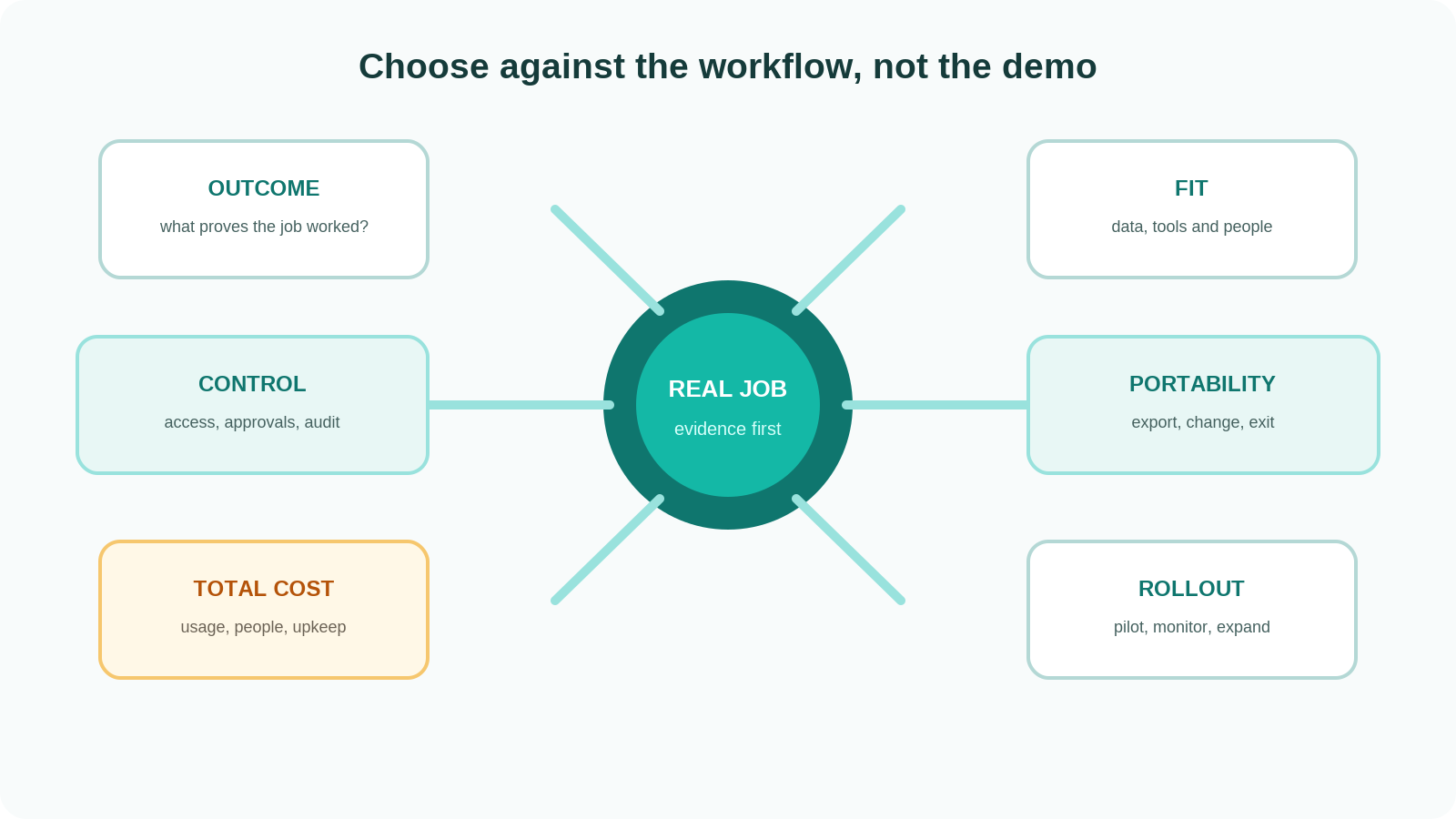
The best AI agent platform is the one your team can prove, govern and operate for a real workflow.
Ask nine questions: what job is being improved, which systems must connect, what data and permissions are required, how will behaviour be evaluated, what is the full cost, who will operate it, what can be exported, how will rollout be controlled and how can you change or leave later? Score answers against the same workflow rather than against vendor language.
1. What job must the platform improve?
Write the workflow before you shortlist products. Name the person starting it, the information available, the repeated steps, the output required and the point where a person must review or take over. If you cannot describe the job without saying “make work smarter”, you are not ready to compare platforms.
Define two or three measurable outcomes: task completion, turnaround time, quality threshold, escalation rate or cost per successful result. This connects the platform decision to the business case rather than to the number of features shown in a demo. Our AI agent use case readiness checklist can help you decide whether the workflow is repeated, reviewable and worth improving.
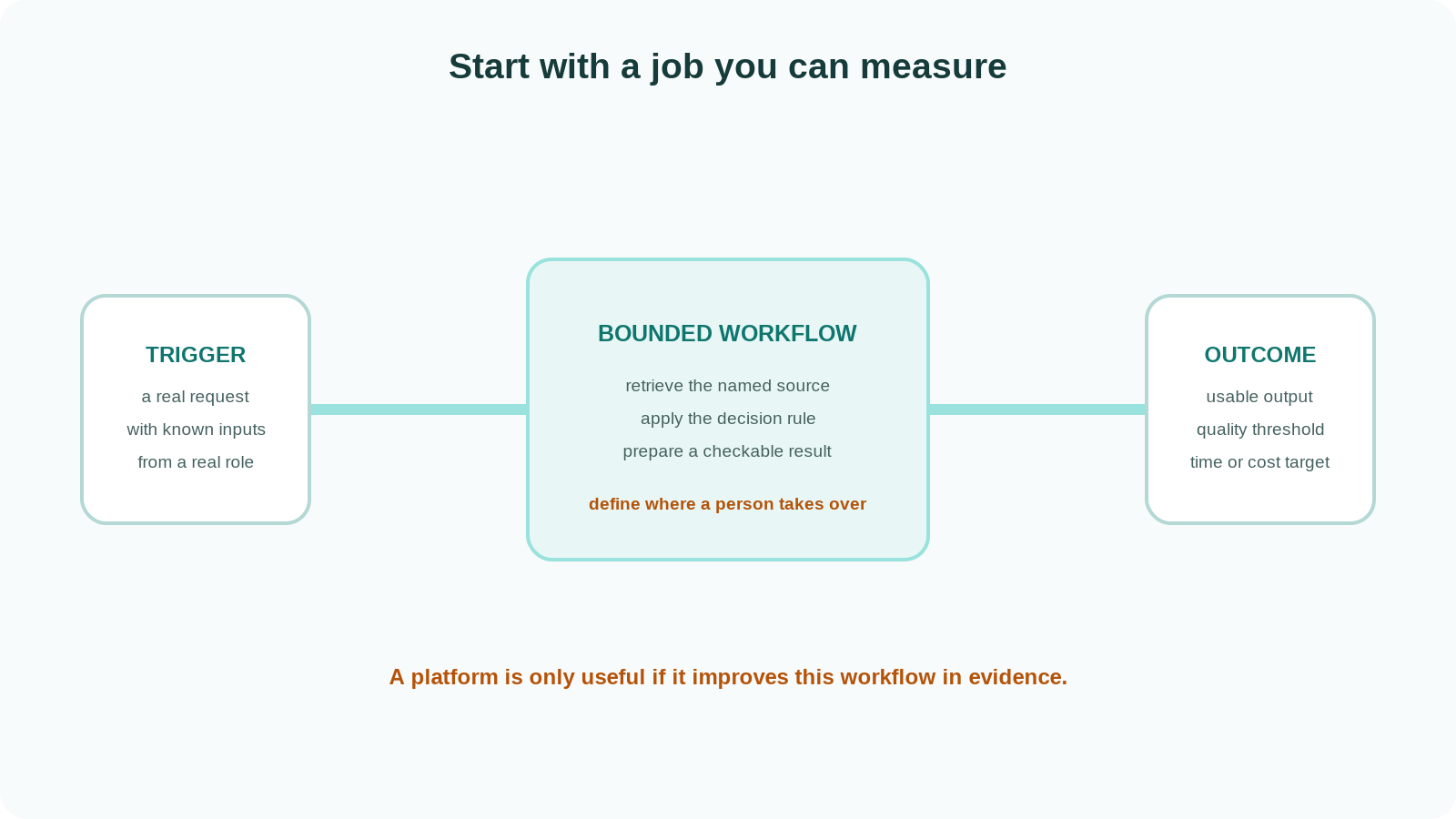
- What starts the workflow and who owns it?
- What inputs and sources must be available?
- What output is useful enough to accept?
- Which outcome will tell you the platform is helping?
2. Can it connect to your data and tools without breaking control?
A model is only one part of an agent workflow. Check how the platform connects to the systems where work actually happens: documents, databases, messaging, ticketing, CRM, email or internal APIs. Then test the awkward cases: missing fields, expired credentials, timeouts, duplicate requests and a tool returning an unexpected result.
Ask how identity and permissions work at each connection. Can the agent have its own scoped identity, or does it inherit a person's broad access? Can you run read-only or dry-run modes before allowing state changes? Microsoft's secure agent process guidance recommends tool governance, continuous evaluation and human confirmation for high-impact actions.
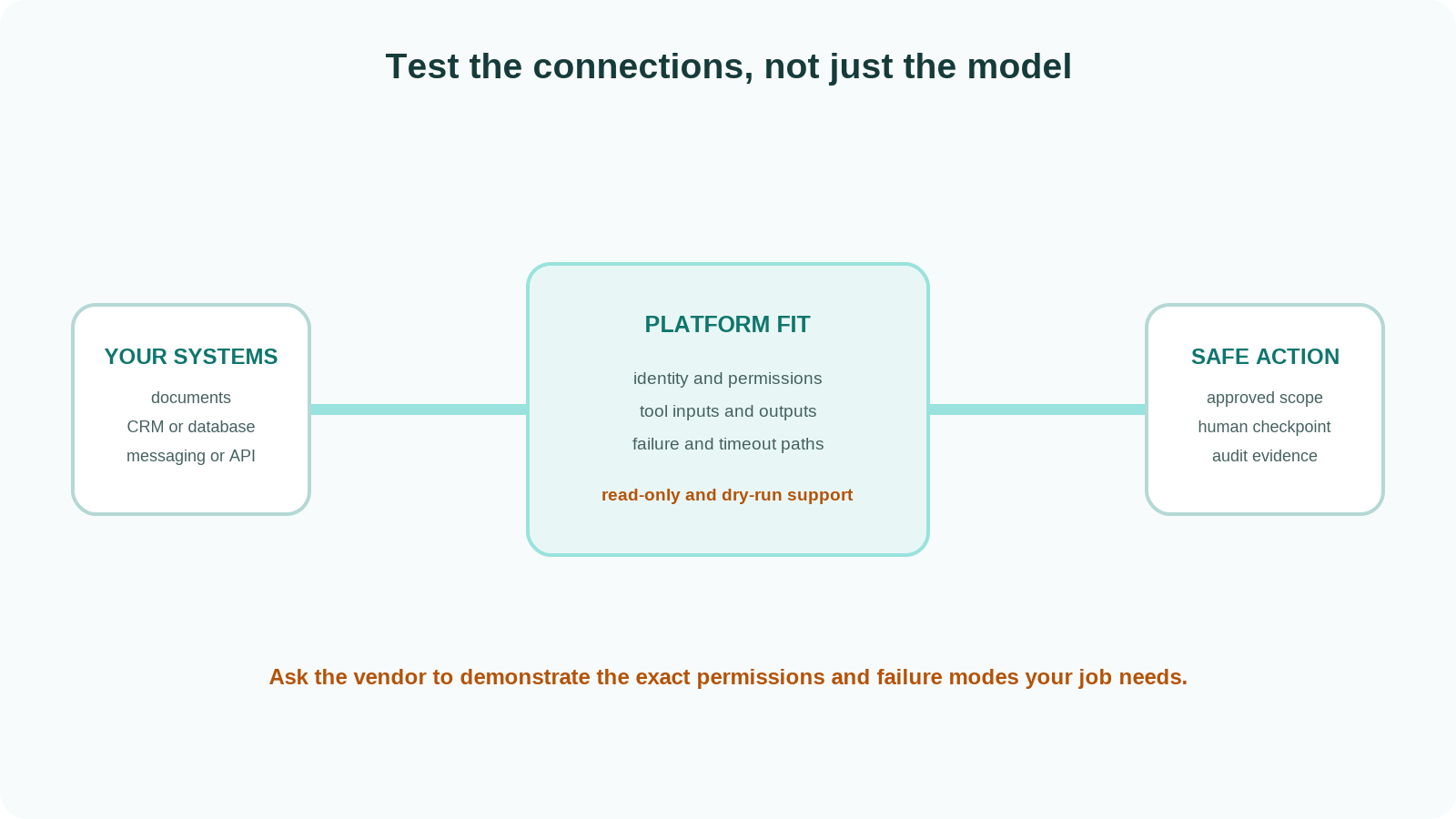
The vendor connects a sample app and shows a successful path with clean data and unrestricted access.
Your team tests the real systems, permissions, data gaps, failure paths and human approval points.
Show us what the agent can see, which identity it uses and what happens when a tool call fails.
3. Can you evaluate what the agent does, not just what it says?
A platform should help you test the workflow's behaviour across representative cases. Measure whether the task was completed, whether the right tool was selected, whether inputs were valid, whether tool results were used correctly and whether the agent stopped safely when it lacked information. Do not accept a single “quality” score with no trace of how it was produced.
Microsoft's agent evaluator guidance separates measures such as task completion, tool selection, tool input accuracy, tool output use and tool-call success. Your platform does not need that exact vocabulary, but it does need a usable way to compare results before and after a prompt, model, tool or knowledge change.
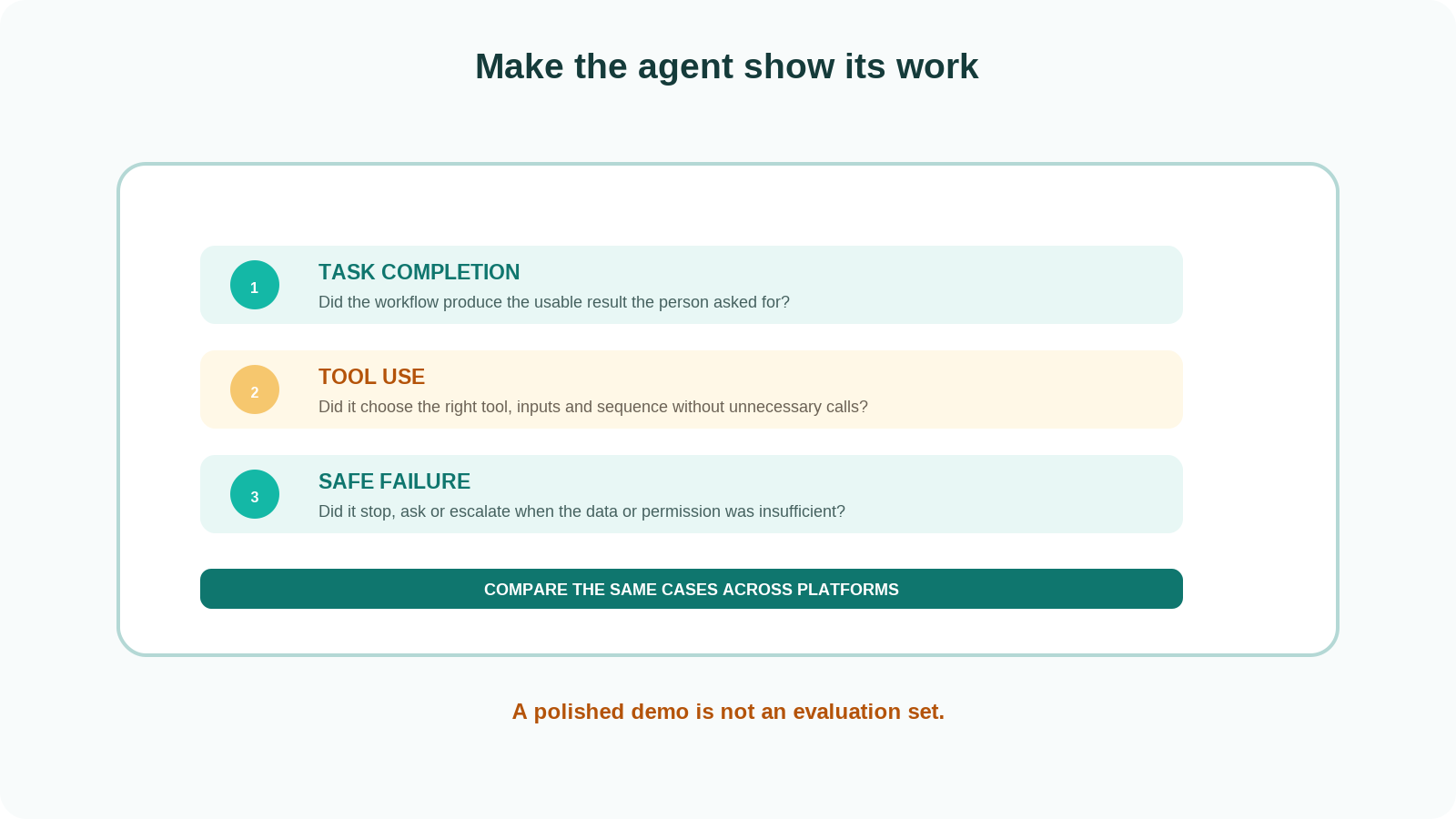
- Can you create a fixed set of normal and edge cases?
- Can you inspect tool calls, inputs, outputs and errors?
- Can you track cost, latency, escalations and task success together?
- Can the same evaluation run after a platform change?
4. What is the total cost of operating the workflow?
Compare more than a licence or model line item. Include usage, tool calls, storage, integration work, testing, monitoring, human review, incident response, support and the time your team spends maintaining prompts, data and permissions. The cost that matters is the cost per successful workflow, including the cases that need escalation.
Ask vendors to model at least three scenarios: a small pilot, expected volume and a failure or review-heavy period. Clarify which usage is metered, which capabilities are bundled, what happens when limits are reached and whether your team can set budgets or stop conditions. Our guide to AI token overspend explains why usage design matters before an agent is rolled out broadly.
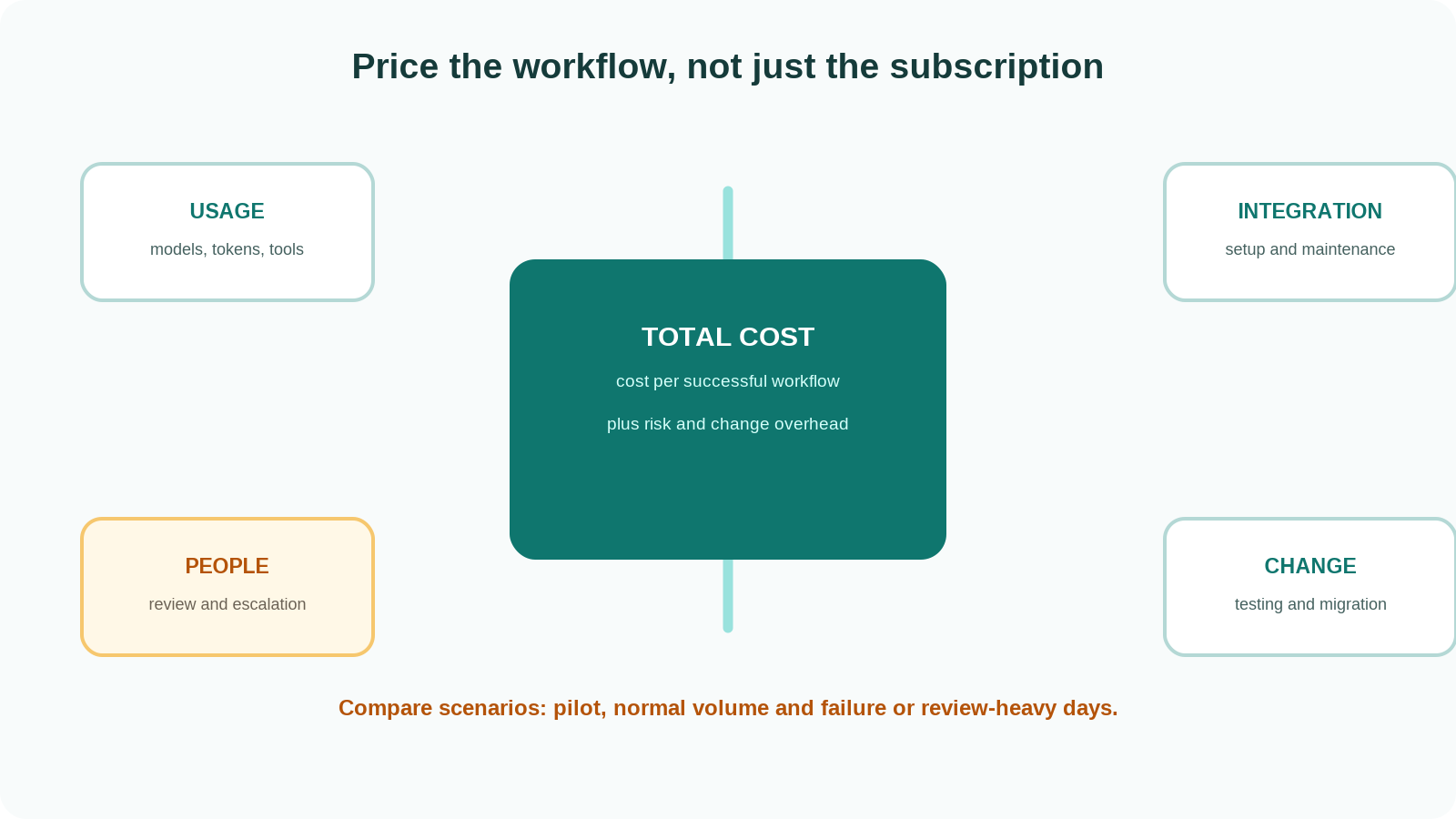
A cheap demo can become an expensive workflow if review, monitoring, failed runs and integration upkeep are invisible in the estimate.
5. Can your team roll it out, operate it and leave it?
A platform decision is also an operating model decision. Ask who owns the agent, who approves changes, who responds when it fails and who reviews access over time. Look for controlled rollout options, audit logs, clear support boundaries and a way to pause or revoke the workflow without a scramble.
Portability is not only about exporting code. Document the workflow, prompts, data contracts, tool definitions, evaluation cases, approval rules and operating metrics in a place your team controls. IMDA's updated agentic AI governance framework highlights bounded risk, human accountability and technical controls across the agent lifecycle.
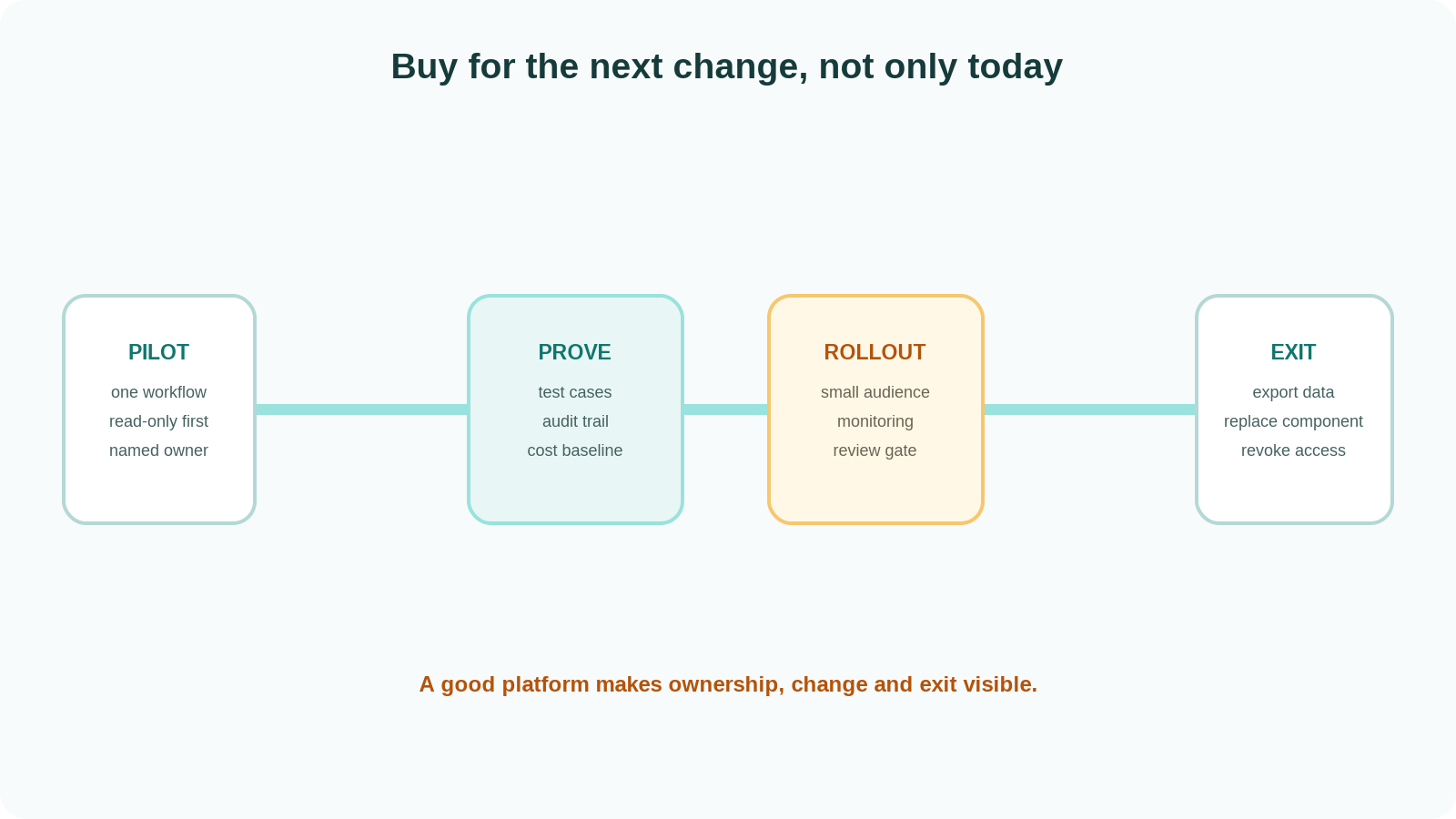
The workflow, evaluation cases and permissions live only inside the platform, so a product change becomes an emergency.
Your team owns the workflow definition, evidence, access decisions, operating metrics and a realistic replacement path.
Frequently asked questions
There is no universal best platform. The right choice is the one that can handle your real workflow with the required data, tools, controls, evaluation, cost model and operating ownership.
Choose based on the workflow and the people who must operate it. A no-code tool may speed up a bounded workflow, while a developer platform may offer deeper integration and control; validate both against the same test cases.
Ask the vendor to run your workflow, show tool permissions, handle a missing input, explain a failed action, display audit evidence and estimate the full operating cost. A generic demo is not enough.
Document your workflow, prompts, tools, data contracts, evaluation cases and approval rules outside the platform. Ask what you can export, replace or continue operating if the vendor changes its product or pricing.
Choose your platform by building a real workflow
A shortlist becomes much clearer when your team maps a real process, builds a small working version and tests the uncomfortable cases. The Applied AI Agents workshop is a practical next step for working professionals who want to understand how agents connect to tools, make decisions and fit into a real workday.
Bring one repeated process and turn the vendor conversation into evidence: one workflow, one test set, one cost model and one clear owner. That is enough to make a better first decision.