The best first AI agent use case is a repetitive workflow with a clear business owner, accessible inputs, reviewable outputs and mistakes that can be caught before they cause real damage. Start there before you automate anything sensitive, ambiguous or hard to measure.
That is the practical search intent behind most "AI agent readiness" questions: teams do not need another list of futuristic ideas. They need a way to choose a first workflow that is worth building and safe enough to learn from. This is also why our Applied AI Agents workshop starts with concrete workflows instead of abstract AI strategy.
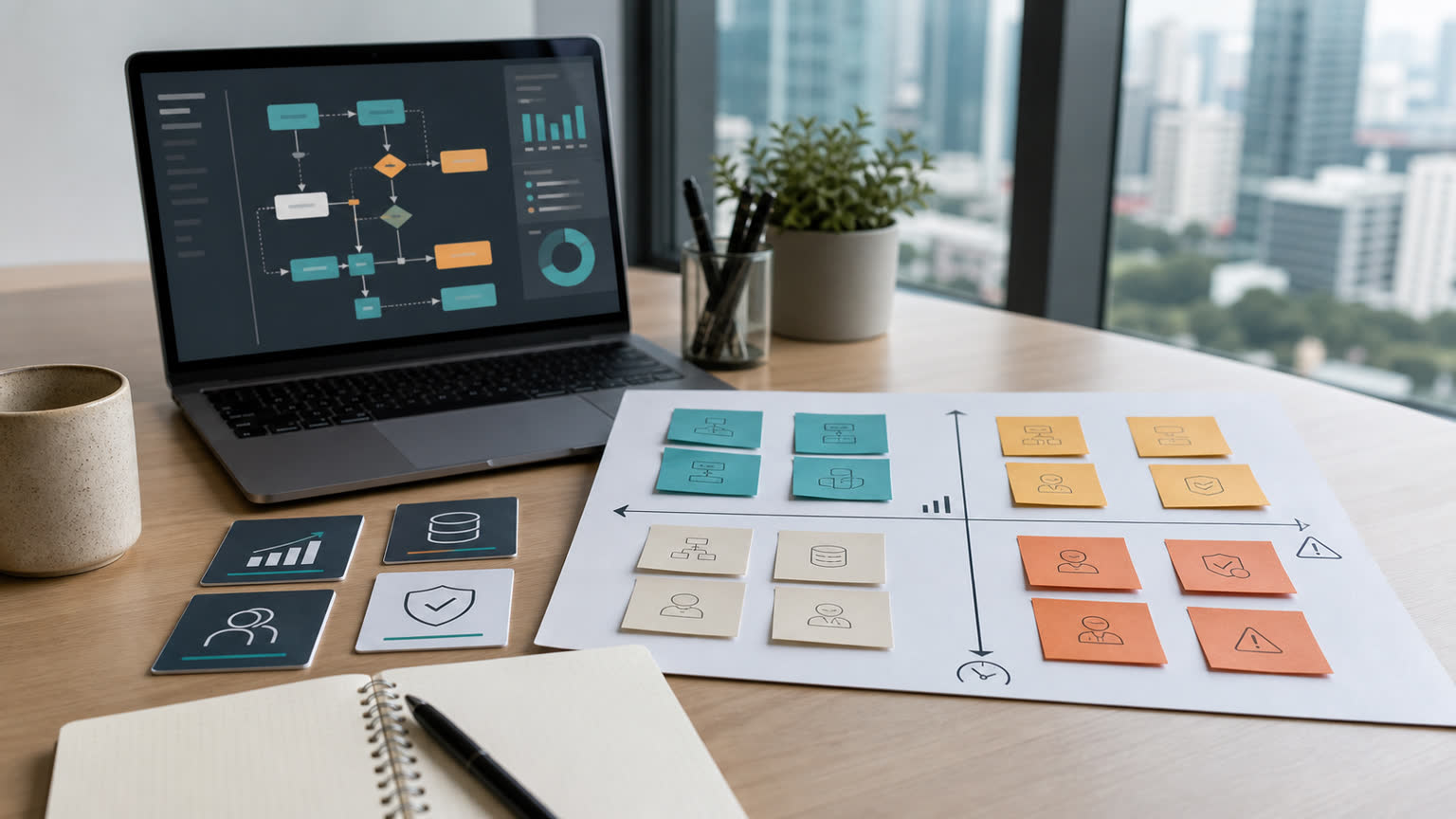
Your first AI agent should teach the team how to build safely, not expose the business to the hardest workflow on day one.
What makes an AI agent use case ready?
- The workflow is repeated often enough for automation to matter.
- The inputs and examples already exist in documents, forms, tickets, messages or systems.
- The agent can work inside narrow permissions and clear stop rules.
- A human can review the output quickly and know whether it is right.
- Success can be measured with time saved, fewer handoffs, faster response or fewer errors.
Start with a workflow, not a tool
A weak AI agent project starts with a tool demo: "What can this model do?" A strong project starts with a workflow: "What task already burns time every week, follows a recognisable pattern, and still needs human judgment at the end?"
Useful first candidates often live in operations, reporting, customer support, marketing, finance admin, recruiting or document handling. Look for a workflow with a clear start, a clear finish and enough repetition that improving it would actually change the team's week.
- Turn intake forms into a structured CRM or spreadsheet update.
- Read recurring PDFs and draft a summary for review.
- Triage inbound requests into categories, priorities and owners.
- Prepare a weekly status brief from existing notes and dashboards.
Use five filters before you build
Before you build an AI agent, score the workflow against five filters: business value, data readiness, permission boundaries, human review and testability. This keeps the conversation grounded in how work actually happens.
- Value: what delay, cost, rework or missed opportunity does this workflow create now?
- Data: are there real examples, source documents and expected outputs to learn from?
- Permissions: can the agent start with read-only access or draft-only actions?
- Review: who approves the output, and what should they check?
- Testing: can you run 20 to 50 past examples and judge whether the output is useful?
Avoid the first-agent trap: too much autonomy too soon
Agent risk rises when a system can call tools, update records, send messages or trigger follow-up actions. The OWASP Top 10 for LLM Applications calls this excessive agency: too much functionality, permission or autonomy for the task at hand.
For a first build, reduce the blast radius. Let the agent draft, classify, extract, summarise or recommend before it can execute irreversible actions. Human review is not a failure of automation; it is how teams learn what the agent is good enough to handle next.
High-stakes, low-volume, poorly documented, broad permissions, no clear reviewer, and hard to know whether the agent helped.
Frequent, bounded, example-rich, draft-first, easy to review, and tied to a visible business metric.
Make governance practical from the first prototype
Governance does not have to start as a large committee. It can start with clear documentation: what the agent is allowed to do, what data it uses, what it must not do, who reviews outputs, and how failures are reported.
This matches the direction of credible AI guidance. The NIST Generative AI Profileframes AI risk management across the lifecycle, while Singapore's AI Verify Testing Frameworkemphasises responsible implementation, evidence and process checks. For business teams, the translation is simple: document the use case before the agent gets access.
If you cannot explain the workflow, the input data, the decision owner and the stop rules, the use case is not ready for an agent yet.
A simple 7-day plan to validate a first agent idea
You do not need a full production build to learn whether an AI agent use case is worth pursuing. Use one week to move from idea to evidence.
- Day 1: write the manual workflow as steps, including exceptions.
- Day 2: gather 20 to 50 real examples and expected outputs.
- Day 3: define what the agent can read, draft, update or never touch.
- Day 4: build a draft-only prototype with human approval.
- Day 5: test against past examples and record failure patterns.
- Day 6: simplify context, permissions and prompts.
- Day 7: decide whether to stop, refine or move toward a controlled pilot.
Frequently asked questions
An AI agent use case is a specific workflow where an AI system can plan, use tools, read or update information, and complete steps toward a business outcome under defined human controls.
The best first AI agent use case is repetitive, painful, bounded, supported by accessible data, low to moderate in risk, easy to review, and measurable within a few weeks.
Avoid starting with workflows that are legally sensitive, customer-facing without review, poorly documented, dependent on messy data, or able to make irreversible changes without approval.
No. Business teams can start by mapping the workflow, defining inputs and outputs, choosing review points, and building a simple guided prototype before moving into production engineering.
Choose and build your first AI agent - hands-on
If choosing and prototyping the right first use case is something you would rather do hands-on, that is exactly what the Applied AI Agents workshop is for. In a practical 3-hour session in Singapore, you build real AI agents from scratch, learn how to think through workflow fit, and see where human review and boundaries belong.
No prior coding experience is required. The goal is not to turn every participant into a software engineer; it is to help business teams understand how agents work well enough to spot useful workflows, avoid weak ones and start building safely.