
The same question, many times a day
The most tiring part of care is often the smallest: the same practical question, asked again and again, each one still needing a calm, familiar answer even when patience is running thin.
Kaki runs on a screen the family already has at home. An older adult simply talks to it and sees a familiar face and hears a familiar voice — a caregiver’s consented likeness — answering the everyday questions that repeat through the day, grounded in details the caregiver controls.
Explore the case studyDementia care is rarely defined only by the big medical decisions. It is also shaped by the repeated, everyday moments: “What day is it?”, “When is lunch?” and “Can you pick up bread?”
Each question deserves a patient, familiar answer. Yet no caregiver can be fully available for every conversation, every minute of the day. Kaki began with a simple design question: how might we make those moments feel supported without trying to replace the person who cares?
It’s 2 p.m. Ah Ma’s daughter is at work and won’t be home for hours. For the fourth time since lunch, Ah Ma isn’t sure whether she has eaten, or what day it is. There’s no one in the room to ask — so the questions go unanswered, and the afternoon feels a little more uncertain.
The most tiring part of care is often the smallest: the same practical question, asked again and again, each one still needing a calm, familiar answer even when patience is running thin.
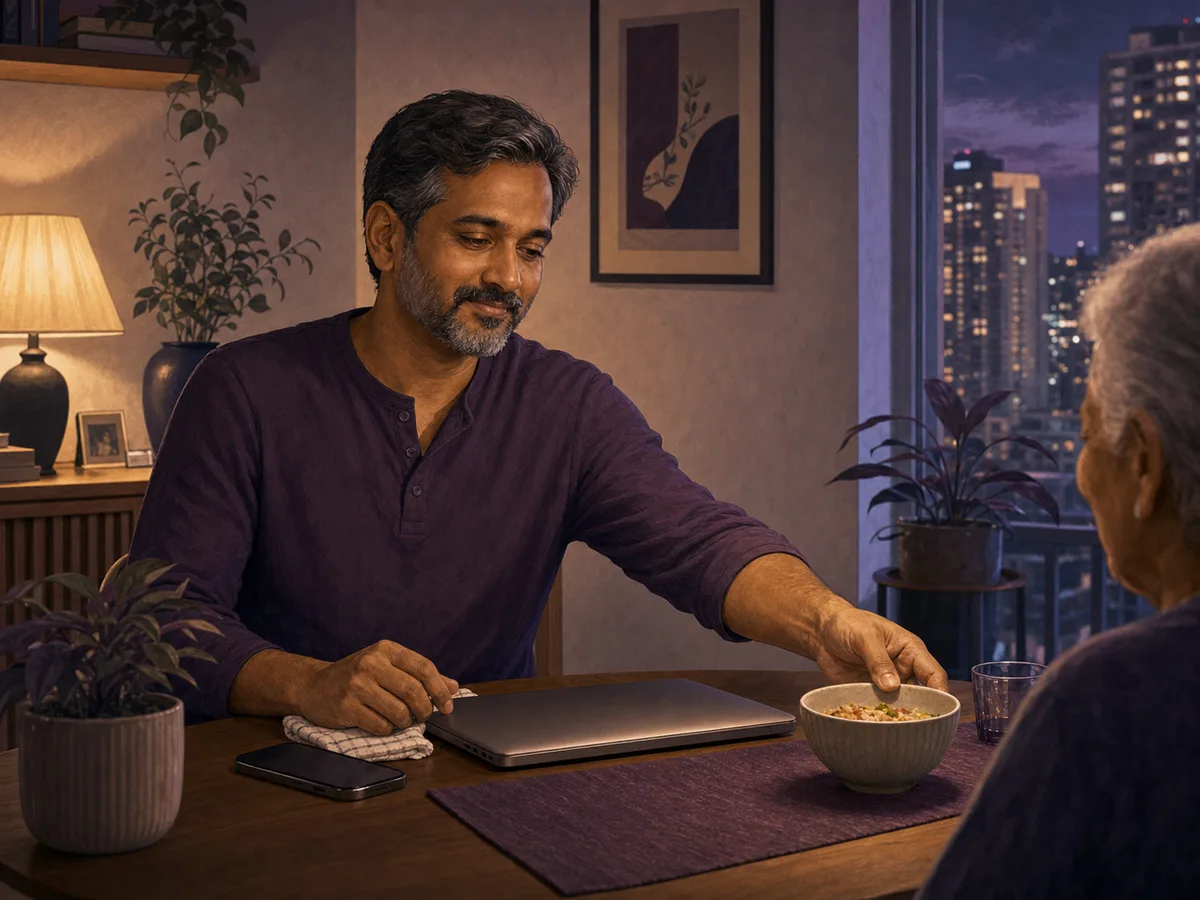
A caregiver can be at work, cooking or asleep and still be the only person who can answer. That leaves long stretches where a loved one is alone with their questions and no one to ask.

A question that changes — asked more often, or about something new — can be an early signal. With no one tracking it day to day, that signal is easily lost until it becomes a crisis.
The scale makes everyday support urgent.
21%+
Singapore is now a super-aged society.
8.8%
That is roughly 1 in 11 older adults.
51.5%
Families can be navigating change before formal support catches up.
S$44.5k
A 2017 Singapore study benchmarked the value of family caregiving.
Sources: National Population and Talent Division (2026), WiSE 2023 study, NUHS (2025) and Woo et al. (2017).
Kaki turns the screen already in the home into a gentle two-way companion. The older adult just talks to it; behind the scenes, a caregiver shapes every answer from a companion app — so responses carry the familiar rhythms, words and reassurance that matter in one household. You can see it in conversation in the demo above.
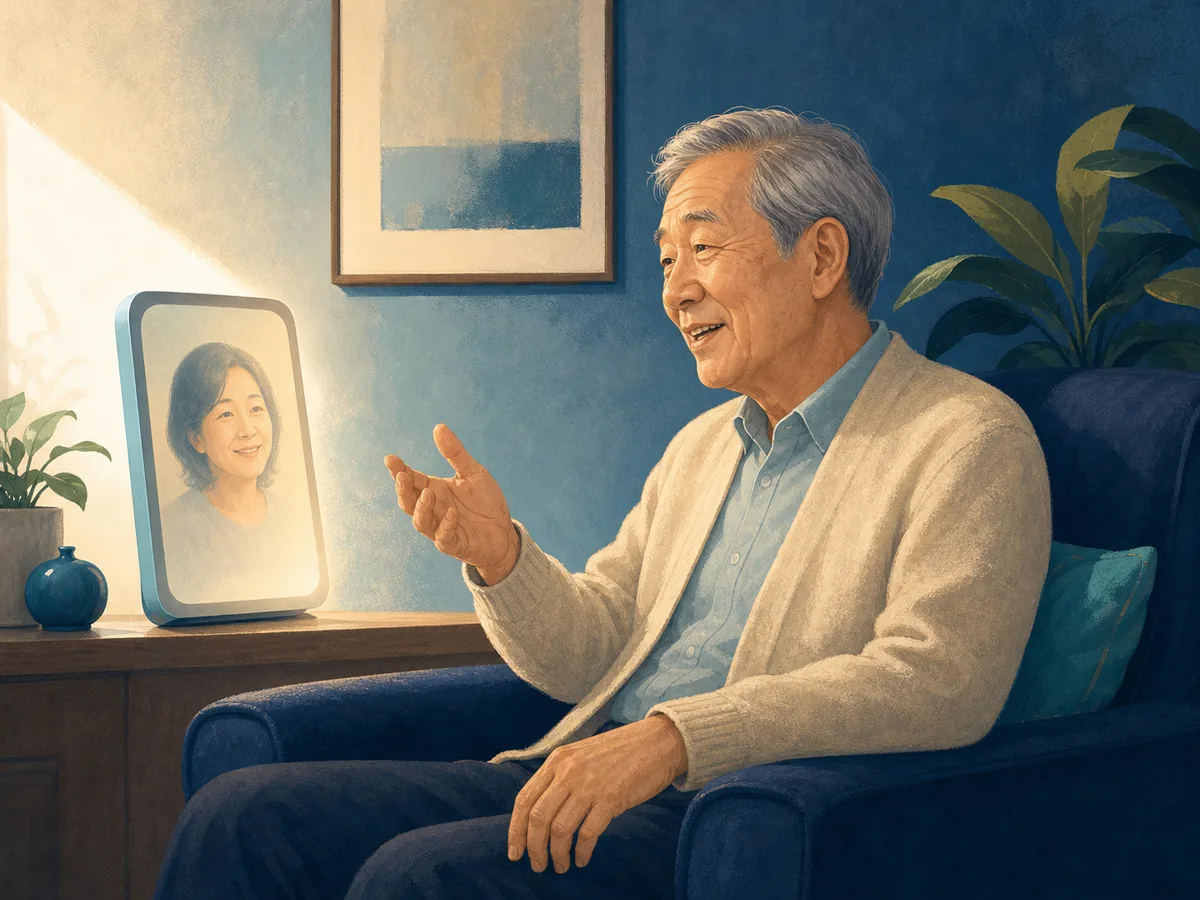
No buttons and no app to learn. The older adult speaks to Kaki naturally, and a familiar face and voice answer on the home screen — the way a family member would.

From a simple companion app, the caregiver keeps Kaki current: daily schedule, meal times, centre visits, medication and the household details that make an answer sound like family, not a chatbot.

Everyday requests (“we’re low on bread”) become a caregiver-ready list, while gentle check-ins quietly log orientation and mood — building a clearer picture of the hours the caregiver can’t be there.
Designed with trust at the centre
The impact
Kaki softens the repetitive layer around care so families can spend more of their time on presence, patience and connection. Here is where that shows up — across clinical engagement, everyday hours and the real cost of informal care.

Clinical outcome
1.5–3hper day
of active cognitive engagement (≈45–90h a month)
Familiar two-way check-ins that exercise orientation, recall, attention and language — replacing passive screen time and idle alone-time.

Caregiver time saved
7–14hper week
of repeated-question time reclaimed
Kaki fields the everyday repeats — “what day is it?”, “have I eaten?” — so caregivers stop answering the same question dozens of times a day.

Cost savings
$2,200per year
in informal-care cost offset
Even a 5% dent in the informal-care burden — about $3,700 a month — adds up to over $2,000 a year.
Important: Kaki is designed to support caregivers and clinical follow-up. It does not diagnose, provide medical advice or replace emergency support.
Analytico AI designs human-centred AI experiences around your organisation’s real workflows, users and measurable outcomes.