The safest way to approach AI agent data privacy is to map the workflow before you build it. Identify what data enters the agent, where it travels, which systems and people can access it, how long each copy survives and which actions require approval. Then remove anything the job does not need.
This matters because an agent does more than generate text. It can retrieve records, call tools, pass context between steps and create new audit or memory stores. Singapore's PDPC data protection obligations include purpose, protection and retention principles, while IMDA's updated Model AI Governance Framework for Agentic AI emphasises bounding agent access and autonomy. This article is a design checklist, not legal advice.
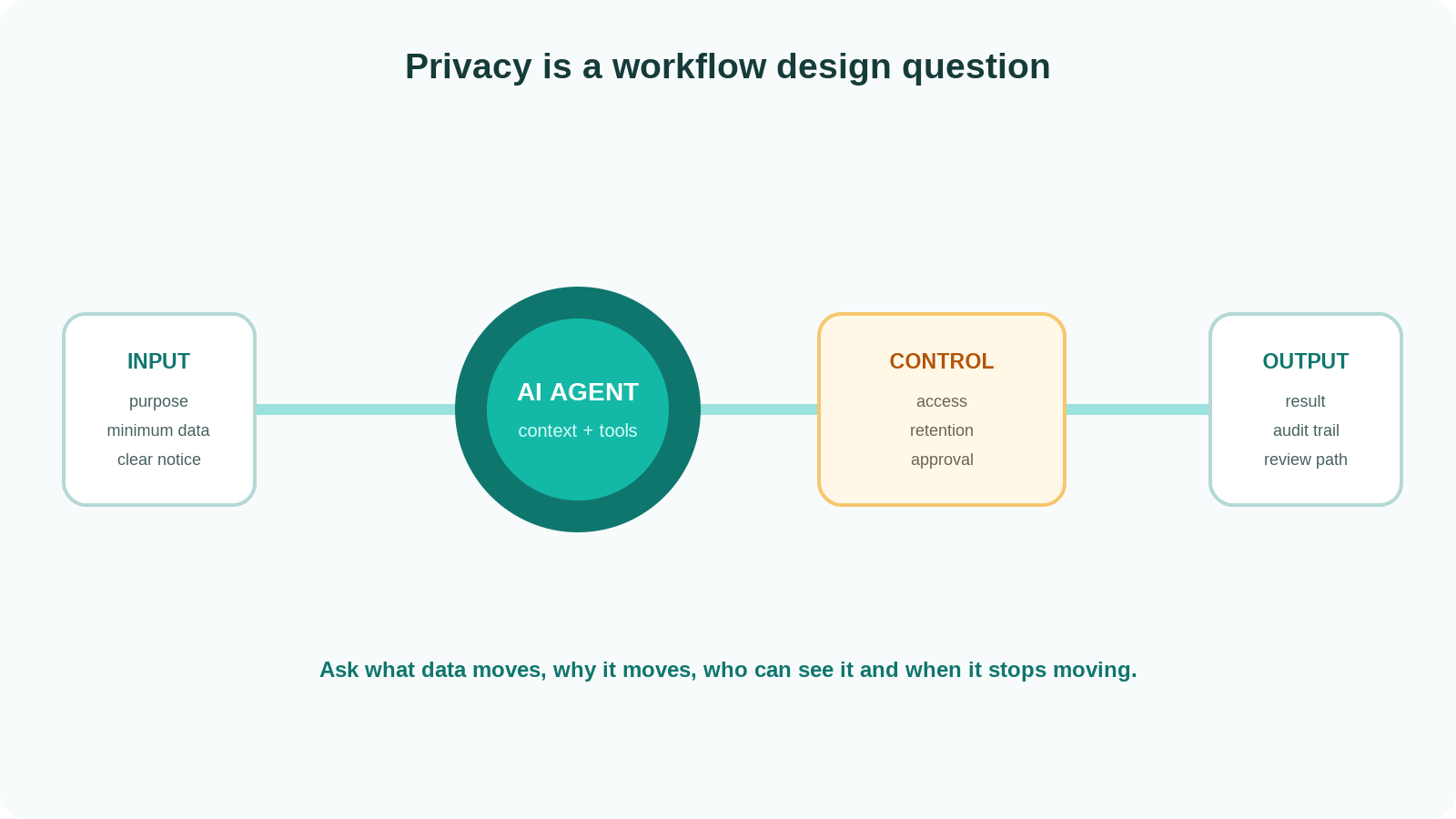
Privacy is not about keeping an agent away from all data; it is about giving it only the data, access and memory its job can justify.
Before launch, answer seven questions: what data enters, where it goes, what can be removed, what is remembered, what can the agent do, where is approval required, and how will you test, audit and explain the behaviour? If the team cannot answer one clearly, the workflow is not ready for more autonomy.
1. What data enters the agent, and where does it go?
Start with an inventory of every data handoff, not just the user's first prompt. Include uploaded files, retrieved documents, CRM records, API responses, tool parameters, agent memory, provider-side processing and application logs. A field that appears harmless in one step can become sensitive when combined with another field downstream.
Draw the path from trigger to output and name the owner of each system. For every arrow, ask whether the data is necessary, whether the receiving system is approved, and whether the transfer creates a new copy that needs its own protection or deletion rule. Our guide to preparing company data for an AI agent covers source ownership and freshness; this privacy pass adds the movement and exposure questions.
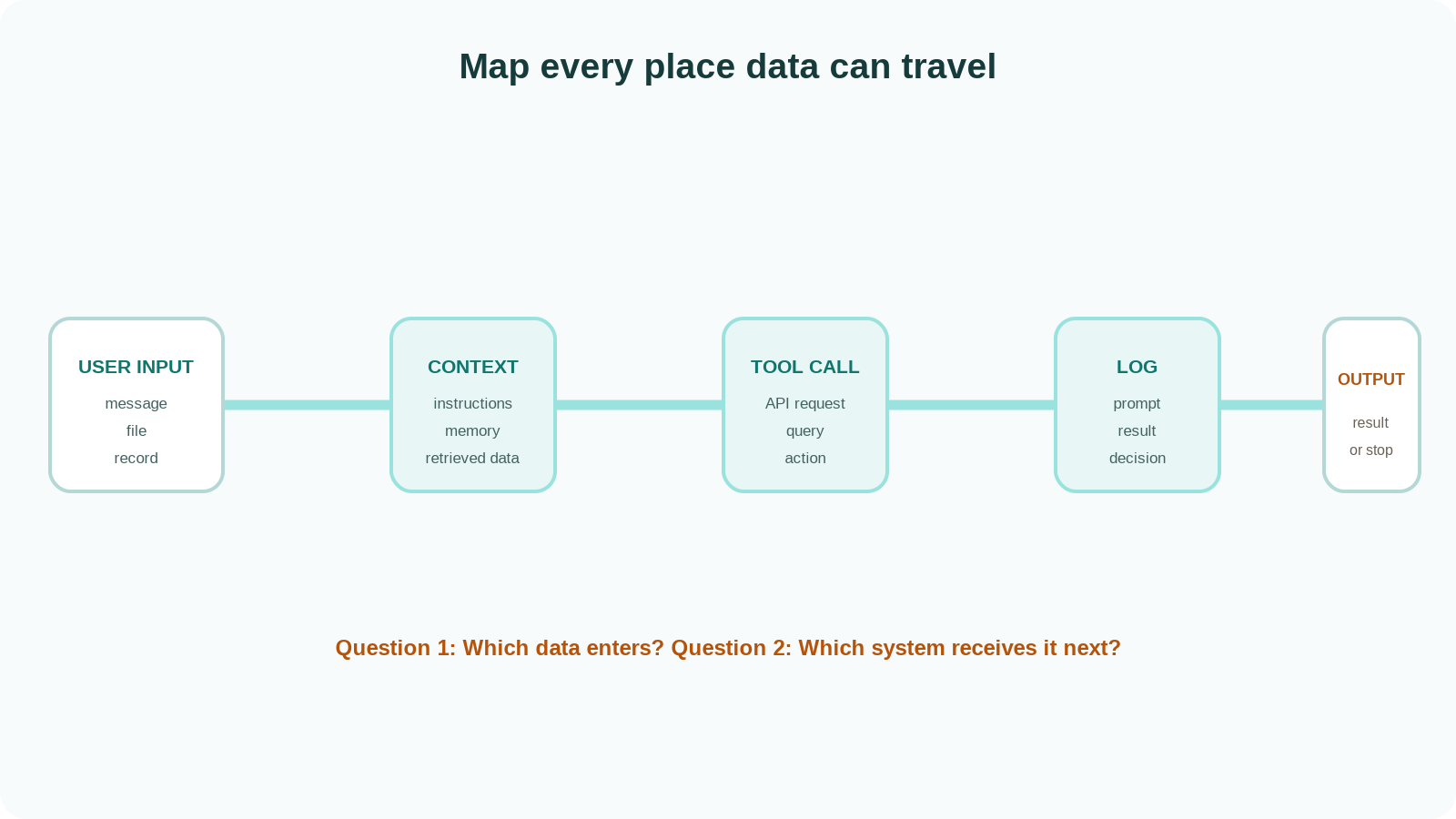
- Which personal, confidential or commercially sensitive fields enter the workflow?
- Which provider, tool, database or log receives each field?
- Where are new copies created, and who owns them?
- What is the purpose for each transfer?
2. What data is actually needed, and who can access it?
The best privacy control is often subtraction. If an agent only needs a customer tier and an order status, do not pass a full profile, free-form notes or an entire database row. Use role-based access, filtered retrieval and task-specific tool permissions so the agent sees the smallest useful slice.
OWASP's AI Agent Security Cheat Sheet recommends least-privilege access, input validation and controls around memory and logging. IMDA's agentic AI framework likewise calls for limits on agent autonomy, tools and data access. Treat access as a workflow decision that must be reviewed when the job changes.
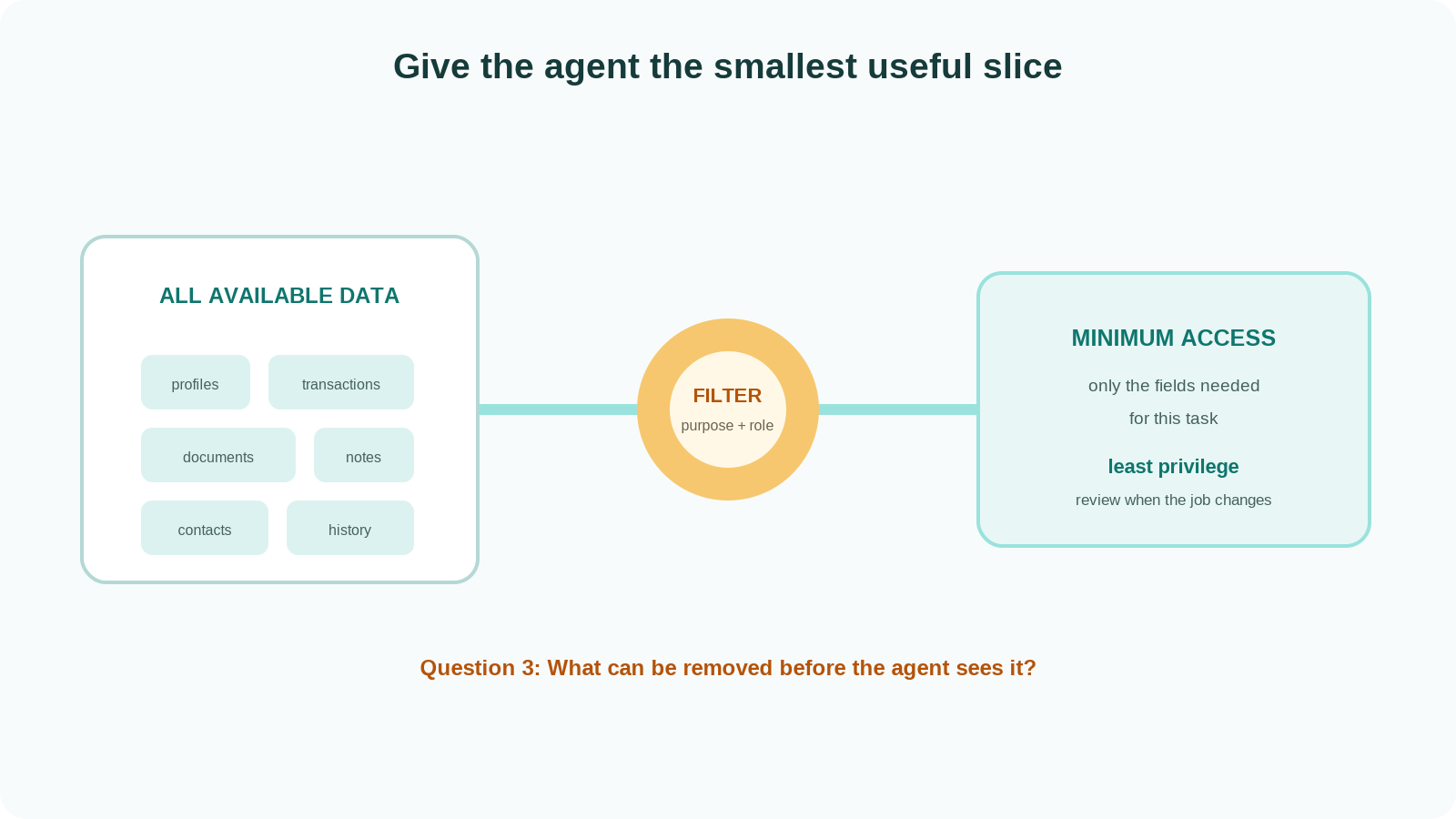
Connect the agent to the whole workspace and rely on the prompt to tell it which records to ignore.
Filter the data, scope the role and expose only the tools and fields required for the defined task.
3. What is remembered, retained or logged?
Do not treat every stored copy as “context”. Separate short-lived task context from reusable memory and from audit records. Each layer needs a purpose, owner, access rule and retention or deletion decision. A useful answer might be: task context expires at the end of the run, approved memory lasts for a defined business purpose, and audit records keep only the evidence needed for review.
Check both your application and your model or tool providers. Ask what they store, for how long, for which purpose, in which region and under which controls. Avoid placing secrets or unnecessary personal data in logs just because logging is enabled for debugging.
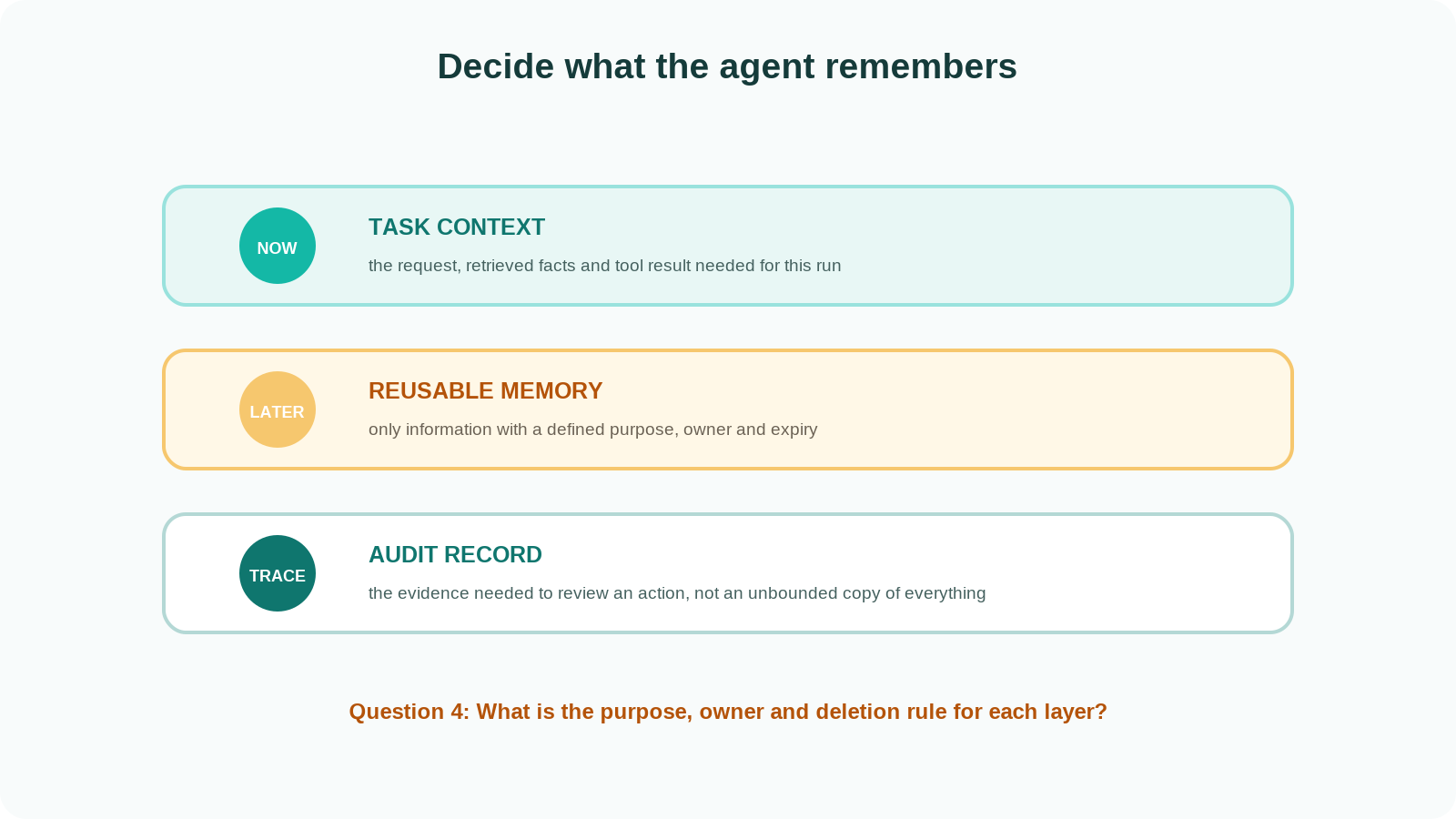
If nobody can explain why a piece of agent memory exists and when it should disappear, it should not be permanent memory.
- What information is available only for this run?
- What information is allowed to persist for a defined purpose?
- What evidence must a reviewer see later?
- How can a person correct or delete the stored information?
4. What can the agent do, and where is approval required?
Reading data and changing a system are different risk levels. Let an agent draft, classify or recommend before it can send, publish, delete, approve, change permissions or move money. For higher-impact actions, show the proposed action, the data it relied on and the reason for the recommendation before a person approves it.
The approval should be meaningful, not a rubber stamp. Set clear checkpoints for actions that are hard to reverse, affect another person, expose sensitive information or create an external commitment. IMDA's framework explicitly describes meaningful human accountability and significant checkpoints as part of responsible agent deployment.
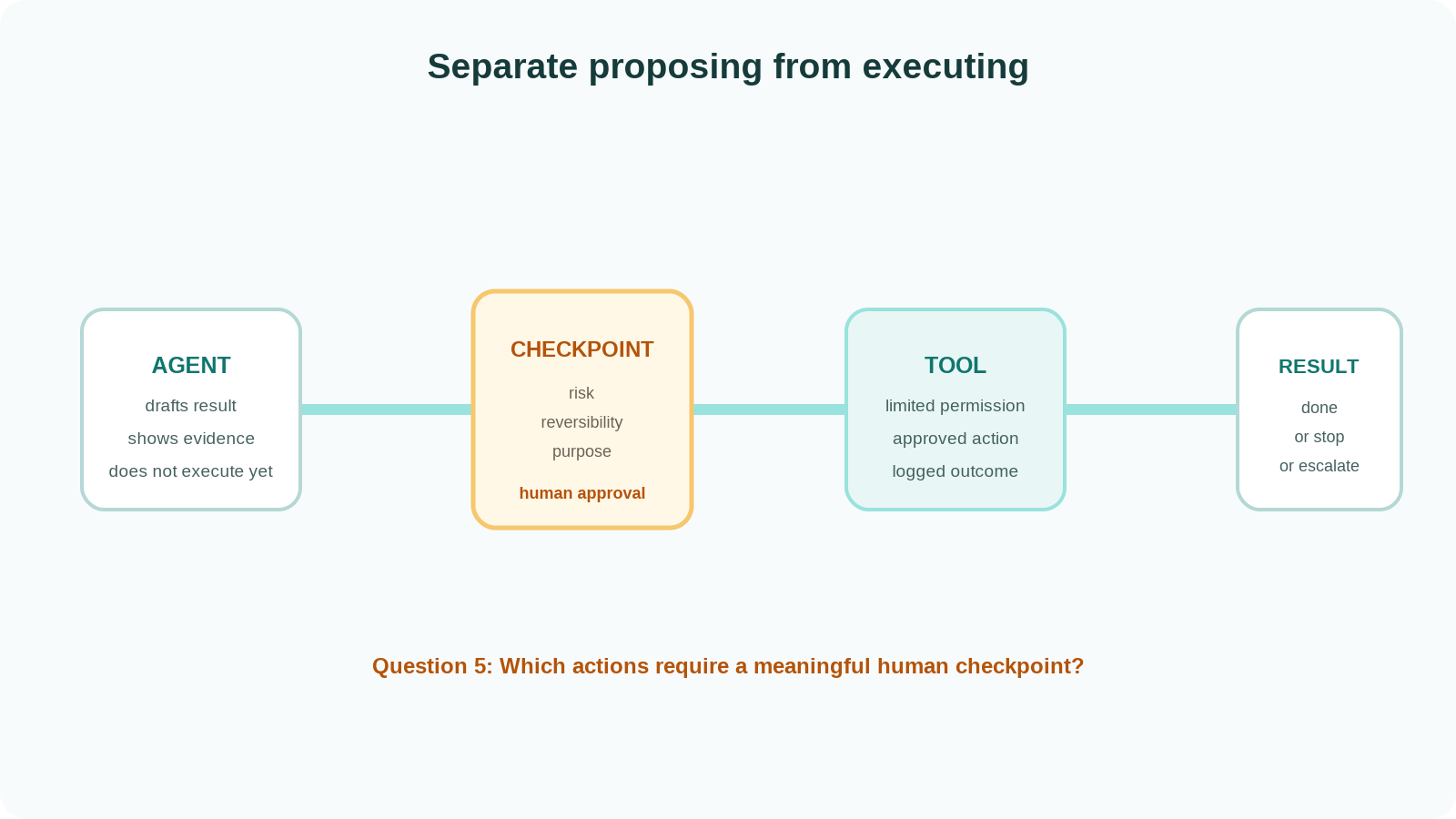
- Which actions are reversible and which are not?
- Which actions affect customers, staff, finances or permissions?
- What evidence must be shown before approval?
- What is the safe stop and escalation path when evidence is missing?
5. How will you test privacy, audit behaviour and explain it?
A privacy design is only credible when you can test it. Use representative normal cases, incomplete inputs, out-of-scope requests, conflicting records and attempts to retrieve data outside the role. Record whether the agent refused, escalated or exposed more than it should. Re-run the same set after every prompt, tool, memory or provider change.
Keep an audit trail that helps a reviewer answer what data was accessed, which tool was called, what the agent proposed and who approved the outcome. NIST's AI Risk Management Framework and its Generative AI Profile provide a risk-management vocabulary, while OWASP's Securing Agentic Applications Guide gives practical security guidance. Explain to users when they are interacting with an agent, what it can do and how to get help.
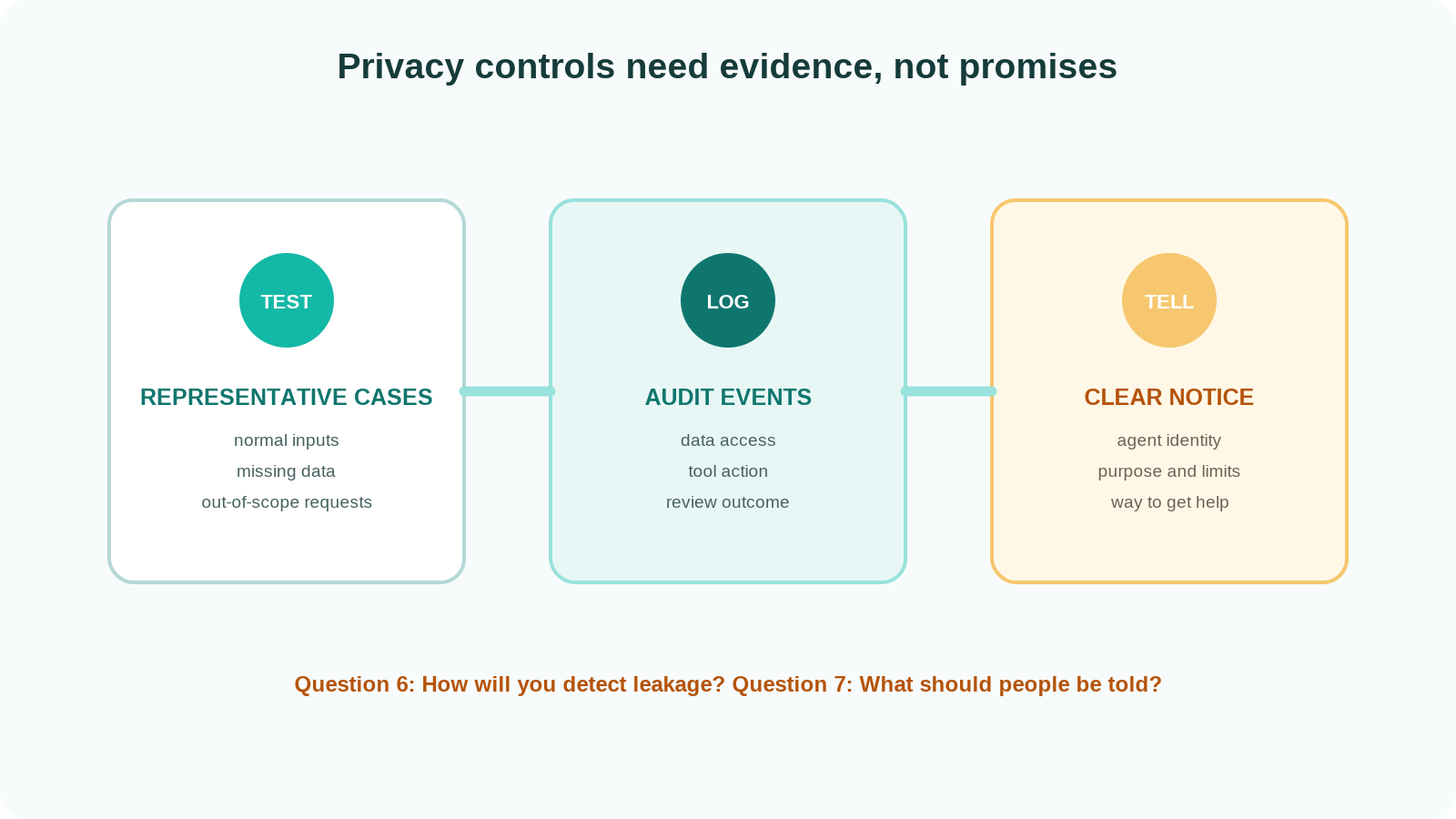
Do not ask whether an AI agent is private in the abstract. Ask which data it can access, which actions it can take and what evidence proves the boundaries are working.
Frequently asked questions
AI agent data privacy is the practice of controlling what personal or confidential data an agent can receive, retrieve, remember, share, log and use to take action.
It should not by default. Start with the smallest set of data and permissions needed for the defined job, then review access when the workflow or risk changes.
Only when there is a defined purpose, owner, access rule and retention period. Separate short-lived task context from reusable memory and audit records.
No. It is a practical design checklist. Your organisation should confirm applicable privacy, security, sector and contractual obligations with the appropriate legal or data protection experts.
Learn privacy-aware agent design by building a real workflow
Privacy decisions become easier when you can see the full workflow run: the data it receives, the tools it calls, the result it produces and the point where a person reviews it. The Applied AI Agents workshop is a practical next step for working professionals who want to build useful agents with clear boundaries instead of treating privacy as an afterthought.
Bring one repeated process and map its data path before you automate it. Start with the smallest useful access, test the uncomfortable cases and make the stop condition visible.